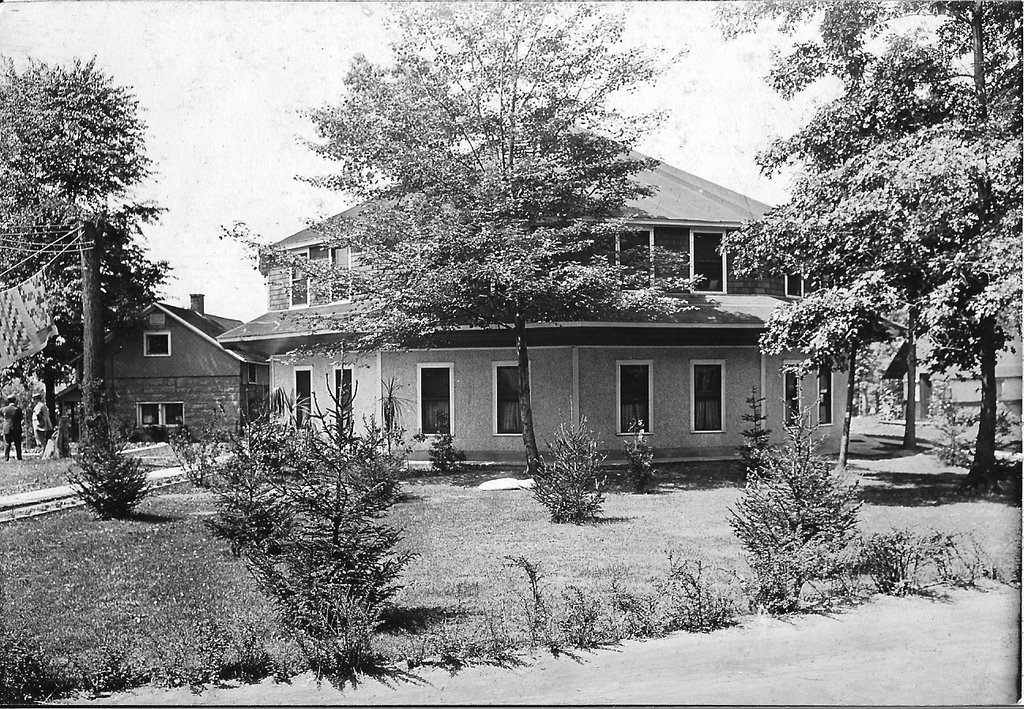
Tuesday, November 17, 2009

Thursday, April 9, 1959: Ground breaking of Patterson Dorm


Ground breaking of Patterson Dorm (it is hard to tell who this is, any Alumni pin point who it is)


Even Mrs. Hazel Davis, with her husband watching, broke some ground.


The interior of one the dorm rooms in Patterson around 1971 or 1972

Going through some the 35 mm slides I acquired I ran across some more treasures. The top two slides that were scanned are from the ground breaking of Patterson dorm on Thursday, April 9, 1959, a little over 50 years ago. Next year Patterson Dorm will celebrate 50 years since it was finished and dedicated. It is great to see all the fun that they are having during this ground breaking to replace the Inner Circle that had been decaying.

Labels: , , , , , ,

Tuesday, November 03, 2009

Treasure Trove of History


The taking down of the Inner Circle Men's Dorm to prepare for Chatlos-Davis


Dr. Patterson putting the "Last" Brick into Chatlos-Davis 1965


The tearing down of Davis Hall (Old Main Building) after the building of Chatlos-Davis

I was given a treasure trove of History yesterday related to the History of PBTS. I had a great time going through the items last night and tonight. They were donated from Richie Robb (son of Ken and Esther Robb). The all the items are great, but my favorite are the 35mm slides. So many great pictures I have never seen. The images above are just a taste of what I have been taking in. I have a device for scanning these to digital form. These images show the work to build the current Main Building on the campus of Davis College, Chatlos-Davis.

Thank you Richie!

Labels: , , , , , , ,

Monday, September 17, 2007

In Memory of Dr. Floyd H. Barackman


In the Fall of 1941, a few months before the attack on Pearl Harbor, a young student entered the grounds of PBTS. His name was Floyd Hays Barackman and he was from Girard, Ohio. He took up residence in the Inner Circle Men's Dormitory behind the Main Building. His class teacher was Miss Alice Chatlos for his first and second year and then the Rev. Marmion Lowe for his senior year.
During him time here at PBTS he met a wonderful woman named Ella Hayes. They would wed soon after graduation in 1944.

His Senior year he also played basketball (as seen below).

His love for PBTS brought him back only a few years after graduation to teach the the school which he loved. The class of 1965 dedicated that year's Theologue to him. Through his time of instruction at the college he wrote several books. His most famous is Practical Christian Theology. Others include Victors not Victims and How to Interpret the Bible. In all he taught at PBTS from 1962-1968, and then from 1968-1993, and he was the Dean of Men from 1971-1980.

Dr. Barackman and his wife Ella had two children, Ruth and Philip.

On Tuesday, September 11, 2007 the Lord which he had served with his whole heart brought him into the realms of glory.

Dr. Barackman thank you for all your labor now enter into the rest of the Lord Jesus Christ.

Labels: , , , , , , , , , , , , ,

Sunday, July 15, 2007

1934 Theologue: The Story of John A. Davis Part 7: "Behold, the Place Wherein We Dwell Is Too Strait for Us"

In part 6 of the 10 part series of the Life of John A. Davis from the 1934 Theologue the Practical Bible Training School was started. In part seven the school moves to its present location on Riverside Drive. I hope you have been enjoying this series. If you have missed any of the posts I have the links listed below, also there is a section on the side column for all of the issues as they are posted to the blog. Keep on reading and enjoying the History of Davis College.

Part 1
Part 2
Part 3
Part 4
Part 5
Part 6

================================================================

VII.

“Behold, the Place Wherein We Dwell Is Too Strait for Us”

II Kings 6:1

The School was rapidly growing and it was realized that it would be necessary to seek larger quarters with dormitory accommodation and campus facilities. Just outside of the city limits of Binghamton, N. Y., there was a notorious amusement park know as the “White City.” The drunkenness and debauchery of the place was unspeakable. Conditions, in face, were so vile, degrading, and unlawful that a separate jail had to be erected on the property to make possible the immediate incarceration of those guilty of the more serious violations of law. The property of the entire neighborhood decreased in valuation. Residents of the neighborhood feared to ride on the street cars going to and from that section because of the undesirable characters so often crowding

the cars.

At this time Evangelist John A. Davis was residing on West End Avenue, in Binghamton, so that in was necessary for him to ride on this street car line on his way to and from the city. Thus, he was familiar with the conditions existing on the cars and also to a certain extent with the conditions prevailing at the “White City.” This amusement resort included 32 acres of land and a number of buildings.

Mr. Davis, always keenly alive to the needs of the School and realizing the possibilities of this place, if it could be secured, one day paid the admission fee through the gates and visited the grounds. He saw the beautiful oak trees, the elms and other trees, among them evergreens, and visualized the possibilities of the place as a permanent home for the Practical Bible Training School. As he walked about the grounds he happened to glance into the bar-room and saw the men and women lined up three-deep around the bar, some of them in an advanced state of intoxication. As he turned to leave, he vowed to himself, “With the help of God I’ll smash this place, “ and with that resolve in his mind, as he was outside of the gate, he knelt beside the high wire fence and prayed to God to give him this place for His work.

This brewery-backed resort was a separate organization for the purpose of selling liquors. As such, it had the backing of the brewery and liquor interests, and any effort to obtain the grounds for other purposes would naturally meet with the determined resistance of those financially interested. This resistance was felt keenly. There was many a struggle and many a prayer. For two years John A. Davis waited for the manifestation of the hand of God. It appears that some of the stockholders, desiring to obtain an advantage, started a fight within the amusement organization which resulted in finally throwing the “White City” corporation into the hands of a receiver. At this time Evangelist Davis was holding a campaign in one of the larger cities of central Pennsylvania.

A Binghamton business man interested in the School, though not aware of Mr. Davis’ hopes regarding the park, secured a short term option on the property and wired Mr. Davis rushed back, and within three hours had called his board together and exercised their option, which gave them title to the property with all the buildings on it, one of the which was a large and roomy hotel.

The transformation which immediately took place on the grounds of the “White City” has been well named a Twentieth Century Miracle. The old “White City Hotel” became the present Main Building, to which have been added wings on either end. The old Beer Garden became Davis Hall; the old Merry-go-round Shelter formed the basis for what is now Mothers’ Memorial, a dormitory housing about forty students; and the jail was rebuilt into a cottage occupied by members of the faculty.

The moving from the old building at 47 Harrison Street, Johnson City, into the new home was accomplished during the month of June, 1911, by the students under the immediate supervision of Francis L. Holden, who later graduated and has been a successful pastor for years. It has been said by one of the students present at that time that the pieces of furniture moved from the wagon to the new building just about as rapidly as things usually come out from a burning building. Of all the workers none was happier than John A. Davis to see this accomplished.

After the equipment had been moved, the hard work of cleaning up began. Every building on the premises had to be renovated from top to bottom, and all the equipment had to be cleaned before it could be used. The articles used in the servicing of liquors had to be destroyed. The kitchen equipment included the usual supply of cooking utensils, all of which had to be received liberal applications of elbow grease furnished by willing hands. In the midst of all this labor, regular periods of devotion were carried on when the students came together and thanked God for the place an for the opportunity of getting it ready for the great days ahead.

The first instruction on the grounds took place in Davis Hall as that was one of the first buildings that could be made ready for school purposes. The teacher was Rev. O. R. Palmer. While the first class was in session a terrible shower came up accompanied by much wind with lightning and thunder. During this storm about thirty trees on the campus were uprooted and much damage was done.

The United States Post Office today is housed in what was the moving picture hall of the old “White City.” Other buildings on the ground were renovated and made usable. A hospital building has been added to the grounds as was also a central heating plant, both of these being down on the bank of the river.

Another of the important buildings on the campus is known as the Manrow Memorial Building. Walter D. Manrow was born on a farm near Throop, NY, April 11, 1846, was converted at the age of twenty-two, and became a successful business man in Auburn, NY, building up a competence for himself in his later years. In the early twenties he became acquainted with the work of the Practical Bible Training School, and he and Mrs. Manrow visited the School on several occasions.

In the meantime the Students’ League of Many Nations had become a permanent organization in the School. The regular buildings were crowded and as many graduates were among the League Students, another building with dormitory facilities was greatly needed. Mr. and Mrs. Manrow finally decided to rebuild a building on the property as a League dormitory building; this was accomplished in 1924-25. It is a commodious building with two floors of dormitory rooms and underneath the building a basement workshop for the grounds, while at the west end of the building where the ground slopes away from the building there is a summer dining room and kitchen.

Another important building on the campus is Friendship Cottage, the home of President and Mrs. Davis, which was built by friends as a tribute of love to them.

A slope of ground at the extreme west end of the campus overlooking the Susquehanna Rive, was set apart for Vesper Services and named “Sunset Knoll.” Seats were arranged in a semi-circular form, a platform was built, and every pleasant evening during the Summer Bible Conference a short service is held here directly after supper. It is on this knoll that the body of Dr. Davis now rests.

In May, 1912, Evangelist Davis lost his voice. This affliction continued for two or three years until he met Dr. Byron W. King of Pittsburgh. Dr. King was a specialist in voice, and under his training the lost voice was recovered. During the acquaintance as doctor and patient, Dr. King came to know about the Practical Bible Training School with the result that he became a lecturer at the School on Voice and Public Speaking, coming to the School at stated intervals. He became one of the most loved instructors among all those who came to the School occasionally, and when Davis Hall was remodeled it was rechristened King Hall as a memorial to Dr. King.

After he lost his voice, Mr. Davis was confined to the School. Though this seemed misfortune, yet it enabled him to give all his time and energy to it. Much of his time was devoted to teaching of Ideal Helps, which became the outstanding class in the School. Evangelists and pastors who have received their training here often have returned to testify to the fact that they owe their success in a large measure to the benefits received in this particular class. In the accompany cut, taken in 1916, Dr. Davis is shown in one of his characteristic poses before the class (below)

It was not the purpose of the founder of the Practical Bible Training School to build a large institution. Occasionally he was heard to say that what he wanted was an institution large enough to train young people properly, on the other hand not so large but that the students would have the advantage of more personal contact with the teachers and the benefit of individual instruction. The student body has averaged approximately 150 students per year for many years. The present year, the student body is somewhat above that number. Students have come to this School, not only from practically every State in the Union, but from Canada and Mexico and many foreign countries including China and some of the countries in Africa. The graduating class at first had but a few members, but the number has grown until the present class of graduates, numbering forty-five, is the largest number of graduates in the history of the institution.

A work of this character must inevitably become known and acknowledged as praiseworthy in a high degree. Such was the case here. Taylor University of Upland, Indiana on June 14, 1922, conferred upon Rev. John Adelbert Davis the degree of Doctor of Divinity in recognition of his outstanding accomplishments in the field of Christian education.

Students training in “rightly dividing the Word” have gone out as pastors and evangelists. Some of the outstanding men of the present decade in these lines of endeavor received their training in the Practical Bible Training School. Missionaries have gone out into Asia and Africa as well as European countries and into many sections of the Western Hemisphere. A great many of the students after taking a course at Bible School Park have returned to their home churches as trained workers in their own individual communities.

------------
Coming up: Part 8: "Precious in the Sight of the Lord Is the Death of His Saints"

Labels: , , , , , , , , , , , , ,

Thursday, July 05, 2007

The first plan of Patterson Dorm?

The first plan of what would become Patterson Dorm? I believe so. In the 1950 Golden Anniversary Theologue there were two pages showing (Yesterday [the old white city hotel] Today [the Main Building of PBTS with two wings] and if the Lord tarries Tomorrow [with this image above]). Some might think that this a plan for Chatlos-Davis, but from the article it is quite clear that it was to be a men's dorm. Here is what the Theologue says:

Our friends here in the Triple Cities and in many other places are saying, “The Lord has done great things for Bible School” and our answer is, “The Lord has done great things for us, whereof we are glad.” As we write these words, we do so with the joy of knowing that the same Lord is your Lord and He waits to do great and difficult things for you, which you know not (Jer. 33:3). What a challenge it is to us when He says, “according to your faith be it unto you.”

The above is the architect’s drawing of our proposed New Building for the Practical Bible Training School For a number of years we have turned students away because of limited accommodation in our dormitories, and with a host of young people anxious for a Biblical Christian training, the proposal become a “must undertaking” for the near future.

This will be a three story, fire-resistant building, with a separate heating plant, of practical design. The first floor will provide a dining room with seating capacity of four hundred, modern kitchen, and parlor. The second and third floors will be dormitory space for one hundred young men, ---fifty rooms, together with parlors, bathrooms, linen closets, and prayer rooms.

The site for the new building is to be just northwest of the Inner Circle toward Sunset Knoll. The estimated cost is $200,000.00. This may seem like a gigantic undertaking, but God is able. The Alumni Association is supporting this effort and a host of friends praying. At the present time we have $35,000 in our fund deposited with the Workers Trust Company in Johnson City.

The Practical Bible Training School of today is the result of the vision of its founder. Not without effort, pain, and trouble has the School come thus far; not without hard work and sacrifice will the future achievements be made possible.

But should anyone think that the work, the program of 50 years, is to stop where it is? The thought is preposterous. We want to make this, the Golden Anniversary year of our School, the greatest in its history.

The leaders are here, the experience is here, the vision is here for even greater advancement. If it is true that, without a vision the people perish, it is equally certain that where the people are obedient to the voice and the inspiration that would lead them to even better and greater things, they attain to heights that at the outset seemed impossible. Please pray that God will undertake for us, and accomplish what may seem like the impossible. He is ABLE.

There are some great information that we glean from this article. Some also is shown in the 1956 16mm film that was made to promote the building project. The First thing I think is so interesting is what was going to be on the first floor. The article says it will have "a dining room with seating capacity of four hundred, modern kitchen, and parlor." I believe these plans were scrapped for when Chatlos was built a few years later. The downstairs of Patterson does not have room for a dining room to sit 400 people. The Second thing I think is interesting is the location of the building. It was to be near the Sunset Knoll Northwest of the Inner Circle. I have created a diagram (below) to show the proposed location using this information and it would have been around where Robb Gym was build around 2 decades after Patterson Hall was finished in 1960.

The 16mm film was proposed a few years later in late 1955 or early 1956 and it was shot at Commencement time of 1956. In the 1957 Theologue it has an article about it:

Our Future Plans

For a number of years we at the Practical Bible Training School have been engaged in a campaign to raise funds for the construction of a new men’s dormitory. Because of the condition of our present buildings, this endeavor is a “MUST” in our program. One year ago last October at their semi-annual business meeting, our Alumni Association voted to put forth an effort to raise $50,000.00 in order to bring our fund up to $100,000.00.

This effort was proposed by a Christian business man, a friend of our school, who requested that we communicate with him when we reach our goal. The campaign is now well organized and our fund has increased to the $68,000.00 mark. Our aim is to complete this drive by commencement, May 1957.

A committee of our Alumni met with the Executive Committee of our Board of Directors and suggested that, perhaps, a colored moving picture showing our present buildings, the personnel of the school, and some of the school activities, might be of great value in promoting this endeavor. They agreed to go ahead with the film and the Alumni Association offered to underwrite the cost of its production.

This film has been completed and had its premiere showing at our Alumni Retreat in October 1956. It is a 1,200 foot film showing not only our buildings and personnel, but also the school in action—actual classroom scenes and many of the commencement activities of May 1956. It is a sound picture with our commencement music in the background and Dr. Gordon C. Davis, President of our school, the narrator. We have two copies of this film and at the present time it is being shown in the churches of our Alumni. It is also available to any of our friends who would like to use it in their churches. Those interested should write Dr. M.C. Patterson, chairman of the Alumni Development Fund.

We are launching out on faith in this campaign, trusting that God will supply this great need. Will you pray with us that the Lord will honor this effort with a real victory and make it possible for us to have this much needed men’s dormitory?

In the film Dr. Gordon Davis, his wife, and Dr. and Mrs. Patterson are walking near the Inner Circle and putting to piece of ground all ready to begin building on. Yet, soon after, and it could not have been very long the location was moved to near Riverside Drive where Patterson Hall is now. I am not sure what caused the change from 1956 to 1958. Either way the dorm was constructed and God provided, as he did for the rest of the buildings that ended up replacing all the older buildings on the campus during the 1960s.

Labels: , , , , , , , ,

Memories of PBTS by Pastor Dick Riffle (class 1943)

MEMORIES OF PBTS 1931-1944

As told by Pastor Dick Riffle, Clarkston, Washington

A little background of how I heard about Practical

I first heard of the Practical Bible Training School in 1931 when my brother Melbourne Riffle began as a student there. He was married, had four children, and in his 30’s when he became a Christian. He was led to the Lord by Pastor Ralph Chaffee in Caton, NY. Pastor Chaffee’s daughter in later years was married to someone at Practical; I think one of the presidents. In 1932 Melbourne and a classmate, Lawrence Kelly decided to hold Evangelistic services in the Grange Hall in Lindley, NY, my home town. The only church there was the Methodist Church and it had dwindled to eight people in attendance. The Minister was a modernist (liberal) and did not preach the Gospel. I was 14 years old at the time Mel and Lawrence held the meetings. Another boy and I had been bass fishing in the Tioga river close by and were coming by the Grange Hall. We heard some singing and the boy with me asked me what was going on. I told him and said, “Let’s go up and listen in.” He said, “Not in these old clothes and hip boots!” I said, “We can sit in the back.” So up the stairs we went and found a bench in the back corner. We propped our fish poles in the corner and listened to the singing.

Soon my brother Mel gave a message. I had been brought up in the Methodist church and was familiar with doctrinal truth but had never heard the plan of Salvation explained so clearly before. When Mel gave an invitation for any who wanted to accept Christ as their personal Savior, I found myself heading for the front, hip boots and all. He carefully explained the way of Salvation and that night I accepted Christ as my Savior. Sunday morning came I could hardly wait to get to the Methodist church to tell my Minister. I was early but he was there. I said, “Rev. MacArthur, I have something to tell you. My brother Mel and a friend have been holding meetings this week in the Grange Hall.” He said very flatly, “Yes, I heard about that.” I replied, “I went forward and got saved the other night!” He said, “That all right son, every young person has to have some EMOTIONAL experience in their life. You’ll get over it!” I was stunned! But it flashed through my mind immediately, “My Minister does not believe the Gospel!”...I turned and ran out of there and never went back to hear him again. When Mel went back to PBTS that fall, he had Pastor Chaffee come every Sunday night and preach for the next year to hold the congregation together. There had been many saved during the meetings. When Mel graduated in 1934 from Practical the group asked him to organize the Lindley Community Church. He wrote the Constitution and By-laws and became the Pastor for one year. This was the beginning of my exposure to PBTS.

It was under the ministry of Pastor Eisenhart that I came to Practical. In October of 1940, I rededicated my life to the Lord when he was Pastor in Lindley, NY. Helen’s sisters, Clara and Dorothy came to live with them. In 1941 I entered the school at the winter term. For the next two and a half years I had to make up the fall classes of 1940 among with my regular subjects. Clara Ruhlman (Clara was the younger sister of Florence Ruhlman, Pastor Carl Wheeler’s wife) came to Bible school in the fall of 1941. At Christmas time, we became engaged. Early in 1942 I received notice that I had been classified as a 1-A and I was to report for duty in the army in June of 1942. June came I got as far as the Induction Center in Rochester, NY. I passed every physical test until I came to the eye Doctor. He asked me if I knew what kind of eyesight I had and I told him, “Yes! 20/20 with my glasses!” He said, “But without them they test 20/400. You are within 10 percent of being legally blind. And I notice you are studying for the Ministry. What are you doing here? Didn’t you ask for a deferment?” I said, “No sir! I come from a very patriotic family and if God wants me in the Army, that is where I want to be!”

I have always believed this man was a Christian because he said, “Son, this country needs SPIRITUAL help as well as winning a war. For every young man who is planning to do what you are going to do, I can get 1,000 young men for the army that are not interested in spiritual things. I’m sending you home to finish your schooling.” I went home and the next week got a job working for the Army on a construction job building an Ordinance Depot for army supplies. I worked until Fall semester and returned to Bible School. My next topic will tell you something about Dr. Gordon Davis.

The draft board had given me a “temporary” 4-D classification (Ministers Classification was 4-D) with instructions that if I was not in full time ministry shortly after I graduated I would be called up again by the Military. Clara and I prayed much about this so before we went home for Christmas met with Dr. Davis in his office. We told him that we wanted to get married before returning for the winter term. He said, “No. It has been a standing rule that students that got married in between semesters could not return until the next fall.” We then told him that we did not want to do as so many young couples had done. Married a week and then separated by going into the military. And that there was a good possibility I would be called again in June. We stated we had prayed about it and felt it was God’s Will.

He got up from his desk and started pacing the floor, pushing his pencil back and forth through his hand (a habit of his). “Well, Mr. Riffle, if I give you permission to let you get married when you go home and let you return, it will break a precedent that has existed since the school began. BUT...If you and Miss Ruhlman believe this is “God’s Will”...Who am I to say it isn’t! You have my permission to get married and return for the winter semester!...In March we went to the Baptist church in Blodgett Mills to preach and the second Sunday they asked us to become their Pastor. I wrote a letter to my Draft Board and shortly after received a permanent 4-D classification.

Memories of Clara and my days at Practical

John R. Clements the writer of the Hymn “No Night There.” Each year on his birthday the student body would gather in front of their home and sing that song for him and also “Happy Birthday.” He was the Postmaster until year of ’43. During the first part of 1943 he was confined to his bed most of the time. Clara and I would drop in once in a while to visit with him. The first time we were in his room we saw something that he never talked about. He was such a humble man. On his bedroom walls hung two large pictures in ornate frames. One was a picture of President Teddy Roosevelt and the other of Williams Jennings Bryan. Each had inscribed a handwritten note, “To My Friend, John R. Clements” signed “Teddy Roosevelt.” On the other picture, “To my Good Friend, John R. Clements,” singed “William Jennings Bryan”...We would always ask him to tell us the story of a hymn, how and who wrote it or some unusual thing about it. The one I remember well was about Ira Sankey, writer of the hymn “The Ninety and Nine.” During the years he traveled with D.L. Moody in speaking engagements, a feature of the service would be when Sankey at the close of the service would play his portable organ and sing “The Ninety and Nine.” Such a service ended in Philadelphia once nigh. Sankey was closing up the organ, the crowd was leaving, and an elderly lady came to the front. She said, “Mr. Sankey, I walked several miles to get here tonight, but I just got here and I came to hear you play the “Ninety and Nine” but I missed it!” Mr. Clements continued, “And then Sankey, the great man of God that he was, who had just played before thousands, opened up the organ and played the “Ninety and Nine” for ONE dear lady!”

Mr. Clements had made a project of researching the history and writing of songs both secular and spiritual.

The Faculty

Dr. Davis and his “Public Speaking” course enabled Pastors to speak clearly when they preached and singers to sing from the diaphragm. John Ruhlman told me this story of when he was a student. One of his class members (William Clancy) was in charge of firing up the boiler to provide hot water for the school. Clancy would get off work about 10:00 at night. Covered with coal dust and sweat, he would get to the Inner Circle Dorm and find guys in the shower and most of the hot water gone. They promised they would save a shower place for him. The next night he came in and someone was in the shower. So he went and got a pail of cold water, crept in the shower room, and dumped the whole pail of water over the wall by the shower on the one who was there. A loud scream came, not from one of the students but from Dr. Davis who had slipped up to the dorm because something was not working in the shower at his house.

It is difficult to be brief about the Faculty. Dr. Lowe with his clear doctrinal and practical teaching of the Word. His humor kept your attention and made a point about some truth he was presenting. His studies and sermons on Ruth and the Song of Solomon have never been matched by any writers that I have read. His devotion to the Lord, God’s Word, his family and his students were outstanding, His book “Christ In All the Scriptures” has never been equaled.

Dr. Harvey Wagner (former FBI Director in Food and Drug Inspection for 15 years before coming to Practical) had a photographic mind. He knew most of the Bible from memory and insisted and encouraged us to memorize as much as we could. When a student gave an answer or made a statement in class, he would always point to that student and say, “Chapter and verse, please!” He gave me a copy of his large Doctrinal and Dispensational chart after his meetings with me when I was a Pastor in Marshall, Michigan in 1945. He was a great man of prayer. His office was connected to his classroom and if you came in early, often his door was partly open and you would see him on his knees in prayer before coming to teach.

Francis Holden was a great in his classes on Biblical Theology and Old Testament History. His godliness also showed in his life and teaching.

Nellie Manley was such a sweet person and made Church History very interesting.

Hilda Copley was a good Teacher and I enjoyed her classes in English and American Literature.

Alice Chatlos was a not only a great teacher of Greek, but a great example of one whose life was lived in the light of Eternity. Her Father being a millionaire, she could have lived a life of luxury and ease but chose to give her life to the Lord at Practical. The only time I can recall her talking about her parents, was when she told us her Dad had sold their home in New Jersey to none other than Glen Miller, the famous orchestra and band director.

Dr. and Mrs. Patterson were great representatives for the school and as leaders of the Students League of Many Nations inspired many young people to come to Practical as students as well as the many who accepted Christ through their ministry. Dr. Patterson also enlisted financial support for the school with the many contacts that he had.

Mrs. John A. Davis (“Mother Davis”) we called was a great inspiration to everyone. She was so thoughtful and concerned for every student. After Clara and I were married, we had a room in the “Brown Cottage” overlooking the river. I was sick one night and she came and made a personal visit on us. One of the chapel features of the year was when she would tell the story of how the “White City” or “Sin City” was purchased as a campus. I will tell it in her words as accurately as I can.

John heard about the property being for sale. He had been looking for a place that was larger than where we were. I will never forgot the day when we drove up and parked out front on Riverside Drive. We began to walk up the sidewalk leading to the main building. As I looked at the scene before us, it was the worse place I had ever seen. Garbage, trash, whiskey bottles, broken glass, broken windows, buildings falling apart, a terrible sight to me. All of a sudden John who was ahead of me, spun around, his face was shining, his eyes full of excitement and shouted, “ISN’T IT BEAUTIFUL! JUST WHAT I HAVE BEEN LOOKING FOR!” I saw only the trash, the work, the rundown buildings. John saw STUDENTS! And a place where they could be taught the Word of God and prepare themselves for Christian service! What a vision he had for God!...”


The Brown Cottage

We were to live in what was called the “Brown Cottage” at school. It sat overlooking the Susquehanna River. We had a single room with a bath. There were three other married couple in the building with similar accommodation. We were on the lower floor near the furnace room which had a small “pony” stove that heated the water tank. It had a single cast iron plate at the top. It was my responsibility to keep the stove burning around the clock. We bought a “cold handle” frying pan, (which I still have) and once in a while would buy some hamburgers and buns and fry them on the little stove.

Each student at the school had to give one hour of work every day. It could be cleaning a hallway, washing dishes, cleaning a bathroom and various other duties. In my Senior year, I was given the responsibility of opening the dining room for the student body. Breakfast at 6:00 am, lunch and the evening meal. I wore a white jacket and stood at the bottom of the stairway as the students came down for meals. As soon as everyone was seated, I hit a small set of chimes with a little mallet and asked a student to say the blessing.

Food at Bible School during those early years was nourishing but not fancy. Lots of macaroni and cheese dishes, and other types of pasta. The girls gained weight, much to their dismay. Meat during the week was mainly cold cuts, no butter, and skim milk. I hated the milk at first but it was always cold and I developed a liking for it. The best meal of the week was on Sunday. It was always the same but very good. Ground beef meat loaf with onions cooked in it. Wow! Did that ever smell good as we came into the dining room!

The school had special music groups that would minister on Sundays to various churches in the area. There were two men’s quartets. One good one and the one in which I sang lead. Carlo Pietropaulo bass, Art Meadows, baritone, Cecil Whitney, tenor. One Sunday we were at a small Baptist Church and before the service the Pastor met with us to instruct is as to when were to sing our first number,

He said, “Right after the S.O.S. group come in, you will sing your first number. Oh, you may wonder who the S.O.S. are: That’s our women’s choir. They know I refer to them as the S.O.S., but they don’t know what that stands for. I secretly refer them as “Sisters of Satan.” They are the WAR department of this church!”

The official Ladies Trio from the School were Clara, Betty Denkleman, Margaret Weckle. Boy! Could they sing! Besides going to churches, they sang at school.

Labels: , , , , , , , , , , , , ,

Thursday, June 28, 2007

Aerial views of PBTS between 1923-1924 (Where are they now?)


Here is a set of photos of PBTS from the air. An airplane flew over the campus in the mid-1920 (1923-1924 would be my estimate, maybe 1925). The photos were put in many Theologues in the late 1920s and early 1930s. This scan is from the 1934 Theologue. Now I love these photos, but I have no idea where the original photos are. I would love to have the original photos back to the school so I can get better scans of them. The pictures show the Main Building, King Hall, the Inner Circle, the fountain, and every other detail of the old campus of PBTS. If you know where these photos are or who might have taken them (from the Binghamton area) please email me. I would love to have much better scans than the ones from Theologues.

Labels: , , , , , , ,

Friday, November 10, 2006

Memories of PBTS from the 1930s- Part 2: Pastor Carl Wheeler (class of 1934)

Memories of PBTS from the 1930s

PART 2

Pastor Carl Wheeler (class of 1934)

Part two in a three part series: Memories of PBTS from the 1930s. Today I am posting about Pastor Carl Wheeler who graduated in from PBTS in 1934.

I first heard about Pastor Wheeler from reading a Touchstone interview his nephew Don Hall did with him and his wife Florence, who went to be with Lord October 2005. I was excited reading about John A. Davis from someone who knew him. I had been emailing back and forth with Don Hall asking what he knew about John A. Davis from his research and he mentioned that he would give me his Uncle Carl’s address. Naturally I thought he would be emailing me his postal address, but no it was his email address! Wow! I was excited. An Alumnus from 1934 had an email address. I was thrilled. We began a great correspondence over email during the later part of the summer of 2006. By the beginning of the school year we had exchanged many emails and I had set up an interview with him over the phone for September. He related many stories over email before our phone interview. One was about him and Billy Sunday:

A PBTS student and I had privilege of a Youth Ministry in what may have been the last campaign of Billy Sunday. A converted well known baseball player, got saved and became an Evangelist which dominated and influenced in the early part of last century. In our ministry in the campaign in the Bronx, N.Y. 1934 we transported "Billy and Ma." Sunday as they were called, from his hotel to the Church. A great honor and here is some thing from my "collection' which is a glowing tribute to the Savior, Billy loved. I have and autographed picture which I treasure and his signature in my well worn Scofield Bible.

In another email over the summer I had asked about the school split of 1932. He recalled this:

The School split during my summer vacation from being a freshman. So much going on in every way and a big problem what to do the next fall. A crucial decision I had to make while sitting alone in a borrowed car and I can't remember the name of that Main Street or avenue. So thankful my steps turned toward Practical and a new Semester amidst questionable circumstances with many of my former teachers not there... My mind says "Floral Ave." Right?

So on Floral Ave Pastor Wheeler prayed and continued to go to PBTS. One other email I received gave me a chuckle. Pastor Wheeler wrote:

Am such a novice. At School learned much about Israelites, Canaanites, Jebusites but know little about Megabytes...Am pre school age in that realm.

Yet, he is the first person I know that is 94 years old that knows how to email and instant message people. I do not know of anyone else. Some of his emails sound like they are from someone that is my age in the fashion they are written. Pastor Wheeler and I became great friends over the internet by the beginning of the school year.

It would be the first Alumni phone interview I would do. It was on Thursday, September 7, 2006

Great energy I heard over the line. Pastor Wheeler told me he was born January 20, 1912 and I could not believe it. I would have thought he was only in his 60s by the energy in his voice. He was born in Susquehanna, Pennsylvania and grew up there before coming to New York to PBTS. His brother Clyde had come to PBTS in the 1920s and had graduated in 1926. Pastor Wheeler also mentioned that one of his oldest brothers was named Earl, and he was killed in WWI. The name Earl was passed on to his nephew Earl Wheeler who is on the Board here at Davis College. It was through the death of his brother that he was able to come to PBTS. God works in interesting ways and usually the ways we will not or do not want Him working in.

Pastor Wheeler remembers going to school for the Summer Conferences. His brother Clyde did much with the Student’s League of Many Nations, while he attended PBTS. He would go around and put up posters to get areas ready for the League’s arrival months ahead of time. Yet, it would be the calling of the Lord to serve Him that drew Pastor Wheeler to attend the alma mater of his brother.

He also mentioned how the League came to Susquehanna, Pennsylvania on several occasions. It was a fasted paced program with flags and patriotism for the countries they represented. It was a three fold service according to Pastor Wheeler that had songs and testimonies of what God had done in their lives. It never dragged, because Dr. John A. Davis was a fast moving kind of person. There would be an appeal for others to accept Christ during the time and also an appeal for others to join in the work of the ministry of Christ. After 80 years these events still are very vivid.

The energy of Dr. John A. Davis also continues to be clear in his mind. He wrote in one of his emails that Dr. Davis had “no grass growing under his feet.” He was very energetic to say the least. Even though he had lost his voice in 1912 and only gained some of it back the energy he had made up for it. He had a Billy Sunday kind of mentality. He could put his foot and kick it up over the chairs when preaching and put emphasis on certain words by inflecting them upwards. Even with the energy he had only some voice. He had a squeaky voice when Pastor Wheeler knew him. From what I know from my own research Dr. John A. Davis lost his voice in 1912 and was only able to regain some of it with some therapy. He had a powerful voice in his days, but with the lack of amplification in the late 1800s Dr. Davis lost his voice preaching to crowds of thousands of people. Pastor Wheeler was thankful for having a great person like Dr. Davis around when he was at PBTS.

During his time at PBTS Ira Weyhe was Pastor Wheeler’s best friend and roommate. Ira was the president of the class of 1934 and also the chief writer for the Theologue of 1934. Another good friend was George H. Kyrk. Pastor Wheeler and two other friends had a trio that would travel to different churches and minister to the congregation. They all lived in the Inner Circle, the converted Merry-Go-Round. The Inner Circle was right behind the Old Main Building and he remembers looking up and knowing exactly where his sweetheart, Florence, was. Sometimes he would write a note to Florence and have the night watchman slip it underneath her door.

He and Florence met while they were doing their different duties on campus. She would work in the dinning hall and he would take her dishes out. Florence would not have been able to stay if it were not for the care that the Davis’ had for the students. They would put some of their own money on the student’s bill or find them other jobs to do around campus to pay for their time at PBTS. It was like one big family at PBTS during the 1930s.

Yet, even with the family unit there were hard days for the school. Being the Depression the food was limited. Sometimes a farm in New York or Pennsylvania would have some extra potatoes and have the students come down and dig them up and take them back to PBTS. Looking back they did not think of themselves as being poor, but being college students even in the 1930s funny things were bound to happen.

He remembers a prank that Florence and some of the girls did on one occasion. They rounded up some cats and released them in the guys’ dorm and caused some excitement. They most likely got in more trouble for getting to close to guys’ dorm than for releasing the cats. Yet, other trials arouse while Pastor Wheeler was there, one being the splitting of the school.

In the summer of 1932 the school split and some professors and students went and formed Baptist Bible Seminary at the First Baptist of Johnson City. As was mentioned earlier in this article Pastor Wheeler remembers praying for God’s guidance on Floral Ave. After much prayer he decided to stay at PBTS. His best friend Ira was still there and Baptist Bible had already started a few weeks earlier. Pastor Wheeler was very thankful he stayed at PBTS, because it would be in 1932 that he and Florence would meet for the first time. To help out Dr. Davis people like Dr. Lowe, a graduate of PBTS came to teach where he would be the rest of his life teaching the Word of God. He believes that the stress both from the death of Charles Davis in 1931 and the school split in 1932 was kept from the student body, but Dr. and Mrs. Davis had to be under immense stress because of both events.

Pastor Wheeler remembers Doctor Wagner very well. Not only him being the class teacher, but he preached the Gospel and loved the Lord. He lived and preached to the students to live as if Jesus were coming back that day. He was also a matchmaker trying to get Pastor Wheeler and Florence together. Many of the professors left churches to take up the burden of PBTS. It was a labor of love; their love for the Lord and their love for the school and its mission.

Another person that he had great respect for was John R. Clements the first president of PBTS. He remembers him writing music and poems all over campus. He would play on his Bilhorn organ also. On one occasion he remembers him writing a poem outside the Inner Circle and he had Mr. Clements write it down for him later on. It was called “On the Jesus Way.” Pastor Wheeler still remembers most of it and treasures its words. It talks about the storms that happened during life and being protected by Jesus Christ. A great man of God who loved his Lord served Him through music and poetry.

In January of 1934, John A. Davis had a series of strokes. The school continued to operate as normally as possible. The classes plugged away. They would have days of prayer and fasting for Dr. Davis’ health. Florence was in a trio that sang at Dr. Davis’ bedside at the cottage. When John A. Davis passed away he remembers the bell on the top of the Main Building ringing 62 times. Yet, even though he was in glory the memory of Dr. John A. Davis would live on.

Pastor Wheeler remembers the Practical Helps that Dr. Davis would give to help people going into the ministry. How to conduct oneself when preaching or visiting a house and the appearance you bring. They were great tips that he has passed down to his children and grandchildren. Dr. Davis gave good practical help for ministers of the Word. He would preach his sermons and be “full of life” and be jumping around. “He was an innovator” for his time doing things that most would not dare to do. He would put things together in a clever way and originate new and different ways to present the gospel (read Education that Educates). A great man of God was Dr. Davis the founder of PBTS

My interview with Pastor Wheeler concluded after one hour and ten minutes on the phone. It was a great phone interview and it was well worth my time to learn more about the rich history of the school. We continued to communicate via email and finally met last month in October here at Davis College. View the picture here. Pastor Wheeler I believe is a living example of era of Dr. John A. Davis, because he has a great bundle of energy and I believe he could jump over a chair.

Coming up next week on Davis College History...Part 3 of 3 Mrs. Ruth Kummerer (Class of 1934)

Labels: , , , , , , , , , , , , , , ,

Monday, October 23, 2006

The Inner Circle


When PBTS moved from Harrison Street in the summer of 1911 to the present location on Riverside Drive the old Merry-Go-Round was converted into the Men's Dorm. I have seen it put many ways: Some Theologues call it "the Inner Circle" others "Mother's Memorial." Either way it is where most of the guys stayed. The Main Building also had some rooms for guys with a large wall between girls' side and guys. Any stories about the Inner Circle Alumni? The location of the Inner Circle is where the Kitchen in Chatlos is now. In the 16mm film "Fruits of a God Given Vision" made in 1956, Gordon Davis tells about replacing it with Patterson Dorm where the men now live.

Labels: , , , , ,