Sunday, July 20, 2008

Charity Von and One Step Closer concerts


One Step Closer

Charity Von
Charity Von
Sharon O'Connor at the Davis College table
A Good turn out for the concert.

Chris Seavey shares his testimonyLarge Thunderstorm that came in toward the end. (Note the water coming into the tent)

Today (Sunday, July 20, 2008) there was a great concert on the lawns of Davis College (where King Hall once stood). It was presented by Andrew's Good News Ministry that had a motorcycle rally yesterday. It was a good turn out on the sunny Sunday afternoon. First to perform was a band called One Step Closer followed by Charity Von. Chris Seavey, head of Youth Minstries at Davis, gave his testimony and invited anyone who didn't know Christ to come to Him today. Toward the end of the concert a thunderstorm came through with a lot rain entering the tent. It was a great day.

Next month Spiedie Fest in Binghamton, August 1-3, 2008. On Sunday, August 3, 2008 (at the fest) Rebecca St James will be preforming.

Labels: , , , ,

Thursday, March 13, 2008

Sports in the early years of PBTS


Here are the sports teams in the 1925 Theologue. Note the clothes that the men and women wore for the sports. According to the Theologue men's Interclass League was started in September of 1923 by Dr. Charles Williams (below)
The girl's athletics consisted "chiefly of Marching Tactics, Calisthenics and indoor athletic games. Besides this the girls played many fast and exciting games of Volley Ball." (p 56 1925 Theologue). Over the years the sports changed, but it wouldn't be until Woodrow Kroll was president that the sports teams began to play on a college league instead of church leagues. There was even a tennis court on campus though I have never been told or seen exactly where it was at one point. Many games were played in King Hall where many of the activities were done until the Robb Gym was completed in 1981.

Labels: , , , , , ,

Monday, February 18, 2008

A bird's eye view of Davis

Rarely do I post twice in one day, but today I was up on the William J. Chatlos-Gordon C. Davis Memorial building's roof getting some photos of the roof. As I was up there I decided to get some good pictures of the campus. Here is a nice one showing the parking lot and the Alice E. Chatlos Library.
Here is a picture of the John R. Clement's Hall that houses the Post Office. Off in the distant is Patterson Hall. The space where the sign is located is the future site of the Ministry Center. That ground housed the Old Administration Building and King Hall.

Labels: , , , ,

Sunday, September 09, 2007

Large storm over campus and Lightning hitting Chatlos

Last night (Saturday, September 8, 2007) at around 11:20 PM lightning struck the Chaltos dorm. There was a large electrical storm with much needed rain for the Binghamton area. The dorm is fine other than at the present time the phone system for the campus is not working. No one was injured, praise God. The lightning strike caused all the alarms to go off and the girls to be evacuated from the dorm to the gym for a short time. The event reminds me of the first classes done on this campus in 1911 and the large storm that occurred. I wrote about in Part 7 of the life of John A. Davis and also in an article about King Hall. The storm caused damaged the campus and destroyed trees. Are there any storm memories of Alumni?

Labels: , , , , ,

Wednesday, July 25, 2007

1925 view of the campus


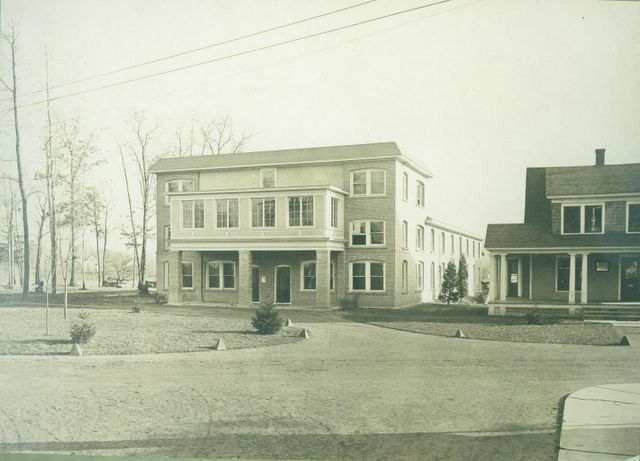
Here is a picture, from I believe, the 1925 Theologue. The quality of scan is not the greatest since the book quality was not that great. The image was taken after 1923 as you can note the School Bell resides on the top of the Lecture hall wing, which was given by the class of the 1923. Also in the picture is King Hall and the Old Administration Building. The original picture, or one of the originals resides in the Alice E. Chatlos library on Davis, but it quite large to be scanned by my little scanner. The Library is located around the same area where this photo was taken some 40 plus years before it was built.

Labels: , , , , ,

Thursday, July 19, 2007

1934 Theologue: The Story of John A. Davis Part 9: "O, Death Where is Thy Sing? O, Grave Where is Thy Victory?"

The days after the death of Dr. Davis were sad days. On Wednesday, March 21, 1934 the funeral of Dr. Davis occurred in King Hall with the Rev. Ernest Crabill giving the main sermon for the funeral. The casket was then taken to the Knoll and the burial occurred.

Part 1
Part 2
Part 3
Part 4
Part 5
Part 6
Part 7
Part 8
================================================================

IX

“O, Death Where is Thy Sing?

O, Grave Where is Thy Victory?

1 Corinthians 15:55

The gray heavens were softly weeping. Nature appeared bowed in sympathetic sorrow.

The vast crowd of people within King Hall were profoundly affected. There were beautiful flowers everywhere at the front of the large auditorium.

That three thousand people crowded into King Hall was in itself a wonderful testimony. Two hundred of the Alumni of the School came from many fields of service. Other hundreds who could not come, sent tenderest messages of sympathy, and expressed as fully as words could how deeply they appreciated the life of the man to whom every student who ever stepped upon the Campus owed so much.

Those who participated in the service were: Rev. Ralph W. Carr, John Fulton, Rev. W.S. Crandall, D.D., Evangelist E. G. Crabill, John R. Clements, Rev. J.M. Siveright, Rev. Fred A. Mills—Dr. Davis’ long time evangelist song leader, and George H. Carr, for years the pianist of the party.

Rev. Fred A. Mills sang “This Day Comes Not Again,” so characteristic of Dr. Davis’ life. Dr. Crandall’s was a most fitting address. In it he likened the struggles of Dr. Davis to a scene which he, himself witnessed in a street in Jerusalem. He described a man staggering along under a huge load of food-stuffs, which he was carrying to a shop some distance down the street, where a group of hungry people were awaiting the arrival of the nourishment. This load bent the shoulders of the man until it seemed as though it would crush him.

This illustration was recognized by all present as most descriptive of the last few years of Dr. Davis’ strain to keep the Bread of Life available still to the students of the Practical Bible Training School.

Reverends Carr and Mills sang beautifully “No Night There.” Following this John R. Clements read from many of the telegrams of sympathy that had come from some of the great men of God of our land.

Mr. Mills sang one of Dr. Davis’ favorite solos; “Live for Others”; after which Evangelist Ernest G. Crabill preached. The sermon began with Tennyson’s “Crossing the Bar.”

“Sunset and evening star

And one clear call for me;

And may there be no moaning of the bar,

When I put out to sea.

But such a tide as moving seems asleep,

Too full for sound or foam,

When that which drew from out the boundless deep

Turns again home.

Twilight and evening bell,

And after that the dark!

And may there be no sadness of farewell

When I embark;

For tho’ from out our bourne of Time and Place

The flood may bear me far,

I hope to see my Pilot face to face

When I have crossed the bar.”

The Mr. Crabill continued:

“It is most fitting that I stand here today at this bier to say some last words ere the body of this GREAT SOUL is carried to its resting place to wait the last trump at the coming of our blessed Lord Jesus Christ.

“Many years ago, this man with whom I found a kindred spirit, talked with me of a day such as this, that would come to each of us, and we entered into a covenant, with each other, to minister at that service in the name of our common Lord.

“I find it has fallen to my lot to perform this service to the best of my God-given ability.

“It was 33 years ago this spring, that I first met this man, at a Gospel service in the Binghamton Railroad Young Men’s Christian Association under whose auspices I had been recently converted.

“He captivated me with his loyalty to God’s Word, and his unbounded enthusiasm, exhibiting a real passion for the souls of lost men.

“We became friends at once, and immediately he began to plan to assist me in my burning ambition to become useful in the service for Christ.

“It was he, who laid the plan for me to enter evangelistic work; and my wife and I became members of his party the following fall; a work that I have followed these years. And no one ever rejoiced any more than he over any success I may have had.

“I knew the last time I talked with him that his work was finished; that the body in which he lived was incapacitated to stand the strain longer in the terrific pace which this great soul had been driving it. But I never will be able to tell just how I felt when the telegram came announcing his death. I felt I was in an earthquake. I took hold of myself, but I still trembled inside. I felt that there was a prince and a great man fallen. I never knew I loved him so much.

“I took my Bible and turned to his favorite text which I had heard him quote so many times. Isaiah 50:7, ‘For the Lord God will help me, therefore shall I not be confounded: therefore have I set my face like a flint, and I Know that I shallnot be ashamed.’

“I thought, how characteristic of this man. He had set his face like a flint, and never wavered. Nothing could turn him from this course. He had a purpose in life. He sought to find the will of God for his life, and when once it was clear, he utterly refused to look back or turn aside.

“If he was knocked down he got up and went on. If he was knocked down again, he refused to quit. There was no such word as ‘defeat’ in his vocabulary. If there were stumbling stones in his way, he transformed them into stepping stones and thanked the Lord for them. If the mountain was high, he summoned more strength. If the job was hard, he took off his coat.

“He undertook great things for God yet nothing was too small for him. It was God’s work. It must be done. He summoned every willing soul he met to assist him in the great work which God had called him. If they quit he still went on.

“He felt God had a place for every redeemed soul and urged all to work hard at his job, knowing that the night was speedily coming when no man can work.

He was the most opposed man I have ever met. He was opposed by friend and foe. His own parents objected to his entering the ministry. His employer in the Boston Store attempted to dissuade him from his conscious call of God. Fowler knew he was a good salesman. He sold more goods in the store, at the post where he was placed, than anyone before or since.

“He was a great leader. He saw a great Light in the Valley. He knew it was of God. He had a real Christ. He must obey. He packed his grip and started to the railroad station to go to Moody’s without money to pay his fare. Like Abraham—he staggered not at the promise he believed God would help him, and he was not disappointed. Who ever had been?

“He drank deep of the wells of Salvation. He absorbed readily from all great saints of God. He coveted the spirit of devotion and usefulness of men like Moody, Whittle, and others.

“He aimed high, he would learn from anyone. He had only one purpose, namely, to spread God’s Truth and do all the good he could for every needy soul. He was the most unselfish and kindhearted man I have ever known. He thought the least of his own comforts, spending and being spent continually for others. He never seemed to think about eating and when he did eat, he seemed unconscious of what he was eating.

“He was always in a hurry—jealous of wasted time, yet cheerful. He liked play and a clean joke. He was frequently saying, ‘While I live, I will be alive; I would sooner wear out than rust out.’—This he literally did. He might have lived to be old, but he cared not for a long life, but for a useful life. How he is to be admired. No day was long enough for him to work for the Lord. He worked on into the night after others were asleep.

“If others were nonplused, not knowing what to do, he came out from a night spent with God, with a plan that he was sure came from Heaven, and summoned everyone in haste to help him carry it out. He thought it was time to rest when his work was finished. He is resting now—Blessed Dead.

“Everything he touched lived—he was a natural Evangelist, he enthused people. Their spirits revived in his presence. He made people want to do something for God and for souls.

“One religious editor said, ‘A great man gone.’ He has left a monument of his untiring zeal, the Practical Bible Training School, and hundreds of Pastors, Evangelists, Missionaries that are throughout the earth, of those he saved and trained.

“He will not know, nor will others, the extent until the Judgment seat of Christ. What a gathering that will be! ‘When the Saints Go Marching In.’

“How he loved this place that God had entrusted to him and how he loved these students. Did he ever turn one away? No! He coveted every one for God and tried his best to impart all God had given him to them to help them multiply their usefulness. God can use me, why not you?

“He made people believe they had some worth and could be used in God’s service. His last request to me and his last conscious thoughts were John 10:27, ‘My sheep hear my voice, and I know them, and they follow me.’

“John Davis has gone. You will see him here no more. His place is vacant—like the felling of a great oak—he will be missed. When you see him again he will not have a frail body, he will be a mighty giant for God.

“No man can fill his shoes. He has carried burdens enough for ten ordinary men. There was only one John A. Davis. God will still carry on His work, He will reveal His plans to others as He has to John. They may not be the same but God’s purpose will not fail.

It is hard to say ‘Good-bye.’ Every friend of mine that goes, makes me almost sorry that I cannot go.

“Over the river faces I see,

Fair as the morning looking for me.

Free from their sorrows, grief and despair,

Waiting and watching, patiently there.

Looking this way, yes, looking this way

Loved ones are waiting, looking this way.”

“Under an apple tree 40 years ago John Davis received his vision of his life work.

“John, I have kept my word. I have done my best; and just one thing more before I have fully kept my covenant with you. I must ask these gathered here if they love your Lord and more.”

Everyone who walked out walked out of King Hall that day, walked out a different person. No one could be in such a service and remain the same. The life of Dr. Davis was vividly and impressively revealed to all.

Two very impressive features of the funeral were the carrying of the casket down a path to the grave on the hillside, through all long row of students formed on either side of the path, many of them with floral displays in their arms; and the other, the many students passing by the grave after the casket had been partly lowered into it, each one as they passed dropping a rose upon the casket of their benefactor and friend.

* * *

The journey from King Hall to the grave was made through a drizzling rain; as if even the Heavens were weeping over the loss the school, the community, and the educational world at large had suffered.

Said one at the funeral: “When we come to yonder hill-slope grave, and have said ‘Ashes to ashes, dust to dust’ I trust we will think, even if we do not speak aloud, in the words of the poet, this fond wish for our friends of their years.

“’Warm summer sun shine brightly here;

Soft southern breeze blow gently here;

Green sod above lie light, lie light;

Good night, dear heart;

Good night! Good night!”

Beautiful the thought, and unusual the experience for hundreds of students, past and present, and for hosts of friends to circle the grave in the falling rain, and as the casket was being lowered sing with strong, confident faith, numerous gospel songs including Dr. Robert Lowry’s great resurrection song:

“Up from the grave He arose

With a mighty triumph o’er his foes;

He arose a victor from the dark domain,

And He lives forever with His saints to reign;

He arose! He arose! Hallelujah Christ arose.”


A pledge to the conviction that Christ having arisen, those who are His will rise also.

--------------------------------
Coming up: The 10th and final part of the life of John A. Davis from the 1934 Theologue.

Labels: , , , , ,

Sunday, July 15, 2007

1934 Theologue: The Story of John A. Davis Part 7: "Behold, the Place Wherein We Dwell Is Too Strait for Us"

In part 6 of the 10 part series of the Life of John A. Davis from the 1934 Theologue the Practical Bible Training School was started. In part seven the school moves to its present location on Riverside Drive. I hope you have been enjoying this series. If you have missed any of the posts I have the links listed below, also there is a section on the side column for all of the issues as they are posted to the blog. Keep on reading and enjoying the History of Davis College.

Part 1
Part 2
Part 3
Part 4
Part 5
Part 6

================================================================

VII.

“Behold, the Place Wherein We Dwell Is Too Strait for Us”

II Kings 6:1

The School was rapidly growing and it was realized that it would be necessary to seek larger quarters with dormitory accommodation and campus facilities. Just outside of the city limits of Binghamton, N. Y., there was a notorious amusement park know as the “White City.” The drunkenness and debauchery of the place was unspeakable. Conditions, in face, were so vile, degrading, and unlawful that a separate jail had to be erected on the property to make possible the immediate incarceration of those guilty of the more serious violations of law. The property of the entire neighborhood decreased in valuation. Residents of the neighborhood feared to ride on the street cars going to and from that section because of the undesirable characters so often crowding

the cars.

At this time Evangelist John A. Davis was residing on West End Avenue, in Binghamton, so that in was necessary for him to ride on this street car line on his way to and from the city. Thus, he was familiar with the conditions existing on the cars and also to a certain extent with the conditions prevailing at the “White City.” This amusement resort included 32 acres of land and a number of buildings.

Mr. Davis, always keenly alive to the needs of the School and realizing the possibilities of this place, if it could be secured, one day paid the admission fee through the gates and visited the grounds. He saw the beautiful oak trees, the elms and other trees, among them evergreens, and visualized the possibilities of the place as a permanent home for the Practical Bible Training School. As he walked about the grounds he happened to glance into the bar-room and saw the men and women lined up three-deep around the bar, some of them in an advanced state of intoxication. As he turned to leave, he vowed to himself, “With the help of God I’ll smash this place, “ and with that resolve in his mind, as he was outside of the gate, he knelt beside the high wire fence and prayed to God to give him this place for His work.

This brewery-backed resort was a separate organization for the purpose of selling liquors. As such, it had the backing of the brewery and liquor interests, and any effort to obtain the grounds for other purposes would naturally meet with the determined resistance of those financially interested. This resistance was felt keenly. There was many a struggle and many a prayer. For two years John A. Davis waited for the manifestation of the hand of God. It appears that some of the stockholders, desiring to obtain an advantage, started a fight within the amusement organization which resulted in finally throwing the “White City” corporation into the hands of a receiver. At this time Evangelist Davis was holding a campaign in one of the larger cities of central Pennsylvania.

A Binghamton business man interested in the School, though not aware of Mr. Davis’ hopes regarding the park, secured a short term option on the property and wired Mr. Davis rushed back, and within three hours had called his board together and exercised their option, which gave them title to the property with all the buildings on it, one of the which was a large and roomy hotel.

The transformation which immediately took place on the grounds of the “White City” has been well named a Twentieth Century Miracle. The old “White City Hotel” became the present Main Building, to which have been added wings on either end. The old Beer Garden became Davis Hall; the old Merry-go-round Shelter formed the basis for what is now Mothers’ Memorial, a dormitory housing about forty students; and the jail was rebuilt into a cottage occupied by members of the faculty.

The moving from the old building at 47 Harrison Street, Johnson City, into the new home was accomplished during the month of June, 1911, by the students under the immediate supervision of Francis L. Holden, who later graduated and has been a successful pastor for years. It has been said by one of the students present at that time that the pieces of furniture moved from the wagon to the new building just about as rapidly as things usually come out from a burning building. Of all the workers none was happier than John A. Davis to see this accomplished.

After the equipment had been moved, the hard work of cleaning up began. Every building on the premises had to be renovated from top to bottom, and all the equipment had to be cleaned before it could be used. The articles used in the servicing of liquors had to be destroyed. The kitchen equipment included the usual supply of cooking utensils, all of which had to be received liberal applications of elbow grease furnished by willing hands. In the midst of all this labor, regular periods of devotion were carried on when the students came together and thanked God for the place an for the opportunity of getting it ready for the great days ahead.

The first instruction on the grounds took place in Davis Hall as that was one of the first buildings that could be made ready for school purposes. The teacher was Rev. O. R. Palmer. While the first class was in session a terrible shower came up accompanied by much wind with lightning and thunder. During this storm about thirty trees on the campus were uprooted and much damage was done.

The United States Post Office today is housed in what was the moving picture hall of the old “White City.” Other buildings on the ground were renovated and made usable. A hospital building has been added to the grounds as was also a central heating plant, both of these being down on the bank of the river.

Another of the important buildings on the campus is known as the Manrow Memorial Building. Walter D. Manrow was born on a farm near Throop, NY, April 11, 1846, was converted at the age of twenty-two, and became a successful business man in Auburn, NY, building up a competence for himself in his later years. In the early twenties he became acquainted with the work of the Practical Bible Training School, and he and Mrs. Manrow visited the School on several occasions.

In the meantime the Students’ League of Many Nations had become a permanent organization in the School. The regular buildings were crowded and as many graduates were among the League Students, another building with dormitory facilities was greatly needed. Mr. and Mrs. Manrow finally decided to rebuild a building on the property as a League dormitory building; this was accomplished in 1924-25. It is a commodious building with two floors of dormitory rooms and underneath the building a basement workshop for the grounds, while at the west end of the building where the ground slopes away from the building there is a summer dining room and kitchen.

Another important building on the campus is Friendship Cottage, the home of President and Mrs. Davis, which was built by friends as a tribute of love to them.

A slope of ground at the extreme west end of the campus overlooking the Susquehanna Rive, was set apart for Vesper Services and named “Sunset Knoll.” Seats were arranged in a semi-circular form, a platform was built, and every pleasant evening during the Summer Bible Conference a short service is held here directly after supper. It is on this knoll that the body of Dr. Davis now rests.

In May, 1912, Evangelist Davis lost his voice. This affliction continued for two or three years until he met Dr. Byron W. King of Pittsburgh. Dr. King was a specialist in voice, and under his training the lost voice was recovered. During the acquaintance as doctor and patient, Dr. King came to know about the Practical Bible Training School with the result that he became a lecturer at the School on Voice and Public Speaking, coming to the School at stated intervals. He became one of the most loved instructors among all those who came to the School occasionally, and when Davis Hall was remodeled it was rechristened King Hall as a memorial to Dr. King.

After he lost his voice, Mr. Davis was confined to the School. Though this seemed misfortune, yet it enabled him to give all his time and energy to it. Much of his time was devoted to teaching of Ideal Helps, which became the outstanding class in the School. Evangelists and pastors who have received their training here often have returned to testify to the fact that they owe their success in a large measure to the benefits received in this particular class. In the accompany cut, taken in 1916, Dr. Davis is shown in one of his characteristic poses before the class (below)

It was not the purpose of the founder of the Practical Bible Training School to build a large institution. Occasionally he was heard to say that what he wanted was an institution large enough to train young people properly, on the other hand not so large but that the students would have the advantage of more personal contact with the teachers and the benefit of individual instruction. The student body has averaged approximately 150 students per year for many years. The present year, the student body is somewhat above that number. Students have come to this School, not only from practically every State in the Union, but from Canada and Mexico and many foreign countries including China and some of the countries in Africa. The graduating class at first had but a few members, but the number has grown until the present class of graduates, numbering forty-five, is the largest number of graduates in the history of the institution.

A work of this character must inevitably become known and acknowledged as praiseworthy in a high degree. Such was the case here. Taylor University of Upland, Indiana on June 14, 1922, conferred upon Rev. John Adelbert Davis the degree of Doctor of Divinity in recognition of his outstanding accomplishments in the field of Christian education.

Students training in “rightly dividing the Word” have gone out as pastors and evangelists. Some of the outstanding men of the present decade in these lines of endeavor received their training in the Practical Bible Training School. Missionaries have gone out into Asia and Africa as well as European countries and into many sections of the Western Hemisphere. A great many of the students after taking a course at Bible School Park have returned to their home churches as trained workers in their own individual communities.

------------
Coming up: Part 8: "Precious in the Sight of the Lord Is the Death of His Saints"

Labels: , , , , , , , , , , , , ,

Thursday, June 28, 2007

Aerial views of PBTS between 1923-1924 (Where are they now?)


Here is a set of photos of PBTS from the air. An airplane flew over the campus in the mid-1920 (1923-1924 would be my estimate, maybe 1925). The photos were put in many Theologues in the late 1920s and early 1930s. This scan is from the 1934 Theologue. Now I love these photos, but I have no idea where the original photos are. I would love to have the original photos back to the school so I can get better scans of them. The pictures show the Main Building, King Hall, the Inner Circle, the fountain, and every other detail of the old campus of PBTS. If you know where these photos are or who might have taken them (from the Binghamton area) please email me. I would love to have much better scans than the ones from Theologues.

Labels: , , , , , , ,

Wednesday, June 06, 2007

White City Amusement Park


Old White City Hotel in center and the Moving Picture building (left) and shooting range (became the Post Office)
Old Hotel

Side of Hotel and fountain in center and Ferris Wheel (right)

The White City Amusement Park on Riverside Drive was founded in 1902. Its official name was Wagner’s Park, but the name White City was what most people called it. The park was backed by a brewery to sell liquors in there. The 1934 Theologue said that “the drunkenness and debauchery of the place was unspeakable. Conditions, in face, were so vile, degrading, and unlawful that a separate jail had to be erected on the property to make possible the immediate incarceration of those guilty of the more serious violations of law.” The property value of the area dropped because of the crime. The Streetcars that when by this area were scary to ride, but John A. Davis had to ride the cars because of where his home was on the West End Avenue of Binghamton. Going by the park with its 32 acres and the buildings on the property made ideas pop into Mr. Davis’ mind. Then one day in about 1908 John A. Davis went into the park after paying admission. He saw the possibilities of the property for PBTS since the Harrison Street was getting crowded. As he was making the walk around he saw the bar and the people that were becoming drunk in there. Mr. Davis so disgusted by the conditions began to leave and vowed to himself, “With the help of God I’ll smash this place.” He kneeled outside the admission gate and prayed to God to give him the Park for PBTS. Late in 1910 after much praying the Park went bankrupt. Mr. Davis was having a revival meeting in Pennsylvania when the park went bankrupt. “A Binghamton business man interested in the School, though not aware of Mr. Davis’ hopes regarding the park secured a short term option on the property and wired Mr. Davis and asked him if he would be interested.” John A. Davis was back within three hours. The transformation began and in June of 1911 (96 years ago) PBTS was moved from Harrison Street to Riverside Drive. The Park became reclaimed and transformed into God’s work. The Hotel to the Main Building, the Movie Picture-Shooting Hall became the Post Office, and the Old Merry-Go-Round became the Men's dorm. In only 11 years the park looked like this (below) from the way it was in the pictures (above) when PBTS first arrived at the Park. The first classes on the Park were held in Davis Hall (changed to King Hall). The building had been either the Roller skating rink or the Beer Garden, I have seen it both ways. While the class led by Rev. O.R. Palmer there was a terrible storm that took down 30 trees on the campus. Over the next decade the campus was changed as the student body continued to grow leading the school into the Golden Years of the Campus in the 1920s.

PS If anyone has any more pictures of the White City Park I would love to get them. These three are the only ones that I have scans of.

Labels: , , , , , ,

Friday, January 12, 2007

Rasing the Roof


The picture above is that of the roof for the Kenneth Robb Activity Center. It is from the Binghamton Press and Sun dated January 28, 1980...Wow over 4 years before I was born! Dr. Schlundt had saved it and it was one of the items I have scanned. The text reads (if it is blurry)
-----------------------------------------------------------------------------------------------
Raising the roof
Michael Sexton guides a roof panel into place for the gymnasium and student center at the Practical Bible Training School, 400 Riverside Drive, Johnson City. School officials don't expect the gym to be complete until early June, so it won't be put into use until the fall semester begins. Gary Harding like Sexton, an employee of Tier Construction Corp., Endwell, operates the crane.

-----------------------------------------------------------------------------------------------
The Gym replaced King Hall as the gym and place for the Graduation ceremonies. King Hall was torn down a few years later.

Labels: , ,

Monday, December 11, 2006

More Screenshots of 16mm films


Here are a few more screenshots to show the color fading facing the 16mm films. The top image is that of King Hall I believe, but I cannot tell from the fading of the color which could be restored. The image below that is a long shot of people outside either the Old Main Building or the Old Administration Building. The three men in the center are from (L to R) Dr. MC Patterson, Mr. John R. Clements, Dr. ML Lowe. The final image is of Dr. Woodrow Brown teaching Theology using Dr. Wagner's Chart. The first two images are from the older of the two 16mm films. The third is from the May 1956 16mm film. Both need to be restored for the future and for better image quality.

Labels: , , , ,

Saturday, December 02, 2006

King Hall


King Hall, the main building pictured above, was the old gymnasium of PBTS. It was used for sporting events as well as graduation. King Hall was the old skating rink of the White City Amusement park. In the article “Reminiscences” by Mary Scotten in the 1932 Theologue, she remarks:

The former skating rink, now King Hall, was the scene of the first gathering when outsiders were with us. While we were eating dinner that day in our new dinning room, terrific thunder storm broke upon the Park, uprooting about thirty trees, and breaking off other. Who is “the prince of power of the air,” and what purpose had he in visiting here just then?

When the building was first converted from the rink it was called “Davis Hall” in honor of John A. Davis the founder. Yet, after Dr. Davis lost his voice in 1912 he became acquainted with Dr. Bryon King.

Rev. Davis received much help from Byron W. King, Ph.D., voice therapist and founder and head of "the world's greatest school of oratory," which was located in Pittsburgh, Pa. In September, 1913, Dr. King gave a series of lectures at PBTS on health and how to keep it. This was the beginning of a long relationship that he had with the school. Until his death in 1924, Dr. King came to PBTS annually to lecture on health and on the use and the care of the voice. The students were always delighted with his Shakespearean dramatizations. (From Dr. Barackman’s book on PBTS history).

In 1919 the building name was changed to “King Hall” in honor of Dr. King. In Dr. Davis’ Education that Educates he tells a little more about Dr. King.

On our beautiful campus here at Bible School Park, New York, we have a building called “King Hall.” It is named after my friend, the late Byron W. King, the noted Lecturer and Teacher. I have heard him stand before audiences and vision a creek, river or lake and with eloquent, descriptive powers, picture its possibilities for power, pleasure, and profit. I have listened as he has told about some filthy old swamp in the center of an island. He would visualize it drained, the island made over and changed into a place of beauty with trees, shrubbery, flowers, beautiful homes, gardens and boats for fishing and pleasure. The swamp was converted into a little lake with a shore line and lovely drive. The creek was dammed up to produce electric power to operate factories, mills, light cities, and furnish clothing, furniture, etc. He saw the land cultivated to bring forth food and wealth. Trees were made into chairs, furniture and carvings. In fact, Byron W. King saw possibilities in everything.

Some of us see only hard, cold, everyday facts; we live in a rut, lose hope and have no vision of better things. Others see the world as a work-shop in which wonderful things can be produced. Someone has truthfully said:

Two men looked out

From behind the bars,

One saw mud,

And the other saw stars.

King Hall was torn down in the 1980s. The stone slabs were the three pillars were still are in the parking area of the where it once stood.


Corey Adams

Labels: , , , , , , , , , ,

Wednesday, November 29, 2006

Anita Harrower's Thoughts and Memories of PBTS (daughter of Woodrow Brown)

The following article is that of the memories of Anita Harrower. Anita is the daughter of Dr. Woodrow Brown who recently went home to glory. To read more about him click on these links at the bottom of this article. I enjoyed her memories of the school in the late 1940s and into the 1950s. Her life as being the daughter of one of the professors at PBTS is an interesting perspective to read. Enjoy the words to follow.


My Thoughts and Memories of PBTS

By Anita Harrower

My father Woodrow I. Brown, graduated from Practical in 1948. Maybe because he had been a teacher before he came to Practical he was asked to stay on as a teacher. We moved into a converted barn on campus in 1949, I think. I was eight years old. We had no indoor bathroom so we had to walk across the road to the basement of the administration building and use the bathroom there. It was kind of scary to me because being a basement it was dark. I tried not to have to use it after dark! My father right away started digging in the back yard. He told my brother Ralph and me that he was digging a swimming pool! We were so excited and talked about the day that we would be able to go swimming in the back yard! To our dismay it turned out to be a hole for the septic tank! There were three children and only two bedrooms upstairs plus the new bathroom. When another child was on the way Dad built on a bedroom and garage on the back to give us more room.

We lived right next door to King Hall and Dad was the basketball coach so we stored the basketballs at our house. I could go over anytime and shoot baskets, that was way cool!

Our neighbor on the other side was Mr. and Mrs. Lowe and their three children. Loyd, Paul and Lucy. Loyd was attending school at that time I think. Mom and Mrs. Lowe became fast friends. Whenever I came home from school and Mom was not at home I knew she was next door. When Mom got her drivers license she and Mrs. Lowe would go shopping every week. Dad said that when Mom got her license he lost his car and his wife! After Loyd married Doris and moved to Washington State Paul went to live with them and finished high school there. He then joined the army and was gone for three years so by the time he came home I was a teenager. He asked his mother who that girl next door was and he was surprised to find out it was little Sissy! (That was my nick name for years)

I loved going to the basketball games and cheering for our guys. Dad went out very often to preach in various churches. If it wasn't a school night I could go with him and I loved to go with him. He was always my favorite preacher in the whole world. I consider myself so fortunate to have been raised on the beautiful campus of PBTS. I remember the wonderful singing & preaching. I was able to attend every graduation and retreat for the years I was there. I loved all the activities of graduation and especially the music. I took piano lessons from Mr. Ackerly, the lessons cost 50 cents! I learned so much from Mr. Ackerly. Every once in awhile he would play a classical piece for me. I would listen and watch in awe and wish I could play like that. That would make me practice harder. I play the organ at my church today and I have Mr. Ackerly to thank.

There were always pranks that the students played on my Dad. One time in class a note was being passed around and as it passed the person reading would look up at the ceiling. Dad saw what was happening and he intercepted the note, it read, "Look at the footprints on the ceiling!" Dad had a little Crosley car at one time and several of the guys picked it up and carried it up onto the front porch of the main building! Of course, Dr. Davis called Dad and asked him how his car had gotten there. The guys had a good laugh about that (after they carried it back down). Mrs. Davis was always looking for things for us children to do. She told us that she would give us a penny for every dead bird that we found! She also gave us a penny for every nail we picked up off the road. Mrs. Davis had a niece named Carolee and she was about my age. Whenever Carolee came to visit I was asked to come and play with her. I felt very privileged to eat lunch at the President's house! We would watch Roy Rogers on TV and eat from TV trays!

One time my sister Mary and I were home alone (Mom and Dad were at a prayer meeting) It must have been close to Halloween because two of the students came to our house and knocked on the door. They had scary masks on and when Mary answered the door we both started screaming and shaking. The students were very embarrassed and took the masks off to show us who they were. We never wanted to be alone after that!

We also got to go to all the parties at school including the Halloween party. One year they had an elaborate dark room that went on and on. You had to crawl through part of it and put your hands in bowls of spaghetti (brains) and grapes with the skins off (eyeballs).

Paul and I were married in October of 1956 and we moved to Calif. We had three children and then Paul became ill with lung cancer. He died in Sept. 1963. Even after we married I could not call my mother-in-law anything but Mrs. Lowe because that is what she always had been to me!

The school is so different now. Our house is gone, Lowe's house is gone, King Hall, the main building, the jail, the inner circle, the house that the Ackerly's lived in, the house where the Davis' lived, etc. I'm sure the presence of the Lord is still very much there and I have my memories of a wonderful childhood.

Some links about her father Dr. Woodrow Brown:

A photo of Dr. and Mrs. Woodrow Brown in 2004.
A memory of Dr. Woodrow Brown from Don Hall (class of 1950).
The Obituary of Dr. Brown.

Labels: , , , , , , ,

Sunday, September 10, 2006

Education that Educates

The founder of our school John A. Davis knew how to speak plaining. Even reading this little booklet I found about education his words still speak. I typed it up because people need to hear what he said. I am guess it was written between 1931 and 1933. The booklet was written earlier and but what I got was an updated version. Not sure, but enjoy:

Education That Educates

By Dr. John A. Davis

President, Practical Bible Training School,

Binghamton, NY

The right kind of an education may be likened to a new automobile. It may cost the owner much, but he knows that it is clean, up-to-date, tested, and tried; one in which he may travel with ease, safety and success. A poor education may be compared with a second-handed car that costs less; one which has been neglected, has poor tires, and is liable to break down when you need it most. Of course, the owner of either car may have a wreck if not careful.

It is one thing to possess an education and it is another thing to be truly educated. It is one thing to be educated and another thing to obtain the right kind of education. There is such a thing as an educated fool; I have seen the species! There is a kind of education that makes a life glow and sparkle with joy, success and service. There is another kind of education that produces a narrow, morbid, selfish, miserable, conceited standard of living. One may have a head full of facts and yet not know how to live.

You may have what some call the best equipment—degrees, diplomas, honors and head-knowledge. It may take years of efforts to obtain these qualifications and yet your life may be on the wrong road; your energies may be invested wrong. I know of some people who have spent years in schools, colleges, and universities, who are called educated but they are not practical or in any way useful. They possess no originality of thought, know nothing of the spiritual realities of life, are obsessed with a selfish mental outlook. And when their pilgrimage on this earth will have ended and the balance sheet is struck, it will be found that they made no contribution to the world in which they lived; they did not properly use the brain, heart and mind which the Maker had loaned them. Can it be said that they were truly educated?

For more than thirty years I have tried to impress the students attending my school that there is a difference between mere theoretical training and true, PRACTICAL education.

First: The best education starts where the Bible begins: “In the beginning God.” The first great fact to grip is the reality of God. There is no other safe foundation upon which to build a philosophy of life. We hear a great about “higher education.” Define your term! If by higher education you mean a system of thought that takes the student away from God and starts him out upon the sea of life without a chart, I repeat Paul’s words, “The wisdom of this world is foolishness with God.” The higher a nation goes that kind of education, the lower it will sink. Before the War Germany gave us an example of that sort of thing; it blossomed in Nietzche and its ripened fruit was the World War...

It is not enough to know about God or study about Him, but to believe that He is the Personal Father of everyone who believes on His Son as the Saviour. This loving Father makes know His will, enlightens our understanding, and moulds the life that is given over to Him...This is the first step toward a real education.

Second: The student must know “the Wonder Book of the Ages.” The greatest Book in the world! When “The Student League of Many Nations” of the Practical Bible Training School was in Washington, the group visited the Congressional Library and learned that it contained three million books. One of our students calculated that if he was to read continually for a thousand years he could not finish the reading of all these books. Yet, there is but one Book that can truthfully called “THE BOOK.” This Book contains the only true explanation of origins, the purpose of life, and the final goal. It reveals the plan of salvation and the hope of eternal glory through Jesus Christ...God has given us two Words: “the Incarnate Word” and the “the Written Word.” John says that “The Word was made flesh, and dwelt among us, and we beheld his glory, the glory as of the only begotten of the Father, full of grace and truth.” In true education, the Written Word also becomes flesh in our lives. We should not only be able to quote the Bible from memory, but get it into our hearts through Christian experience as God’s eternal truth built into mind, soul, brain life and character. II Timothy 2.15 is then the next step in building a victorious personality.

Third: We should know ourselves. “Know thyself.” While we study books, we should also study ourselves—our faults and weaknesses, as well as, our virtues and good qualities. You can count yourself richer the day you find a new fault in yourself. To be at our best, we should study our parents, back two or three generations, to know what we have inherited, and resolve by the Grace of God to overcome our inherited weaknesses, natural limitations and faults, by using every obstacle as a stepping stone to something better. God has a perfect plan for every life and by knowing one’s self, one can better cooperate with the Holy Spirit in finding adjustment to that plan.

Fourth: We should study to know others and by seeing weak and strong traits of character in them, it will aid us to overcome our own weaknesses. The man at your side is an open book which you will do well to try to read. We should not study others from the standpoint of being critical; let us always strive to be constructive in all that we say and do. It is well to seek the presence and fellowship of those who are able to bring things to pass, in order that we may profit from their successes. Seek your neighbor’s good, not his goods. How many times a clean, noble, unselfish life has inspired others, particularly young men and women to higher and better achievement!

Fifth: No man’s education is complete, whether he is training for the pulpit, the farm or the professions, unless he acquires at least a general knowledge of the scientific principles of modern business methods. The fundamental of modern business is Salesmanship. We are all in the selling business. This does not mean that our wares are always sold in terms of so many dollars and cents. Paul was a master salesman. He sold the Gospel to the Gentiles. This is to say, he knew the underlying principles of exchange; he knew the underlying principles of exchange; he knew how to invest his efforts in a manner to awaken desire for what he had to offer. Since the true measure of success in life can be computed only in terms of service rendered, then it behooves us to be qualified to invest of our talents in the widest sphere possible and to do this we must know how to sell our goods. Russell H. Conwell’s famous lecture “Acres of Diamonds” was nothing more than a statement that there are great opportunities at your finger-tips if you are trained in the business of knowing how to cash in on them.

These are a few of the practical things which are essential to true education and I have sought to outline them in a simple conversational way with the hope that they will be helpful to some young life in getting a solid foundation upon which to stand in this day of opportunity, a time which is also cursed by ever increasing temptations.

On our beautiful campus here at Bible School Park, New York, we have a building called “King Hall.” It is named after my friend, the late Byron W. King, the noted Lecturer and Teacher. I have heard him stand before audiences and vision a creek, river or lake and with eloquent, descriptive powers, picture its possibilities for power, pleasure, and profit. I have listened as he has told about some filthy old swamp in the center of an island. He would visualize it drained, the island made over and changed into a place of beauty with trees, shrubbery, flowers, beautiful homes, gardens and boats for fishing and pleasure. The swamp was converted into a little lake with a shore line and lovely drive. The creek was dammed up to produce electric power to operate factories, mills, light cities, and furnish clothing, furniture, etc. He saw the land cultivated to bring forth food and wealth. Trees were made into chairs, furniture and carvings. In fact, Byron W. King saw possibilities in everything.

Some of us see only hard, cold, everyday facts; we live in a rut, lose hope and have no vision of better things. Others see the world as a work-shop in which wonderful things can be produced. Someone has truthfully said:

Two men looked out

From behind the bars,

One saw mud,

And the other saw stars

Labels: , , , ,