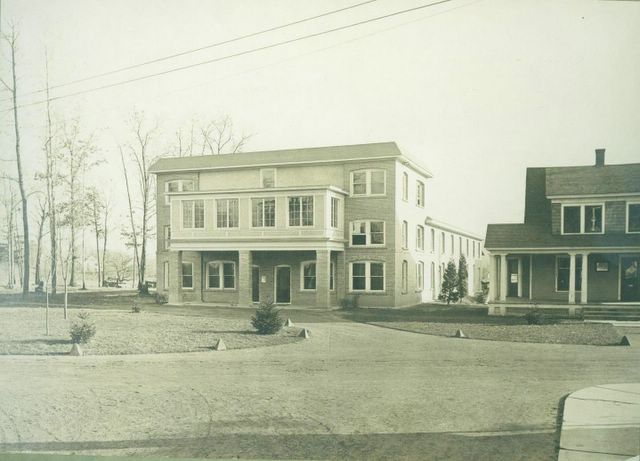
The founder of our school John A. Davis knew how to speak plaining. Even reading this little booklet I found about education his words still speak. I typed it up because people need to hear what he said. I am guess it was written between 1931 and 1933. The booklet was written earlier and but what I got was an updated version. Not sure, but enjoy:
Education That Educates
By Dr. John A. Davis
President, Practical Bible Training School,
Binghamton, NY
The right kind of an education may be likened to a new automobile. It may cost the owner much, but he knows that it is clean, up-to-date, tested, and tried; one in which he may travel with ease, safety and success. A poor education may be compared with a second-handed car that costs less; one which has been neglected, has poor tires, and is liable to break down when you need it most. Of course, the owner of either car may have a wreck if not careful.
It is one thing to possess an education and it is another thing to be truly educated. It is one thing to be educated and another thing to obtain the right kind of education. There is such a thing as an educated fool; I have seen the species! There is a kind of education that makes a life glow and sparkle with joy, success and service. There is another kind of education that produces a narrow, morbid, selfish, miserable, conceited standard of living. One may have a head full of facts and yet not know how to live.
You may have what some call the best equipment—degrees, diplomas, honors and head-knowledge. It may take years of efforts to obtain these qualifications and yet your life may be on the wrong road; your energies may be invested wrong. I know of some people who have spent years in schools, colleges, and universities, who are called educated but they are not practical or in any way useful. They possess no originality of thought, know nothing of the spiritual realities of life, are obsessed with a selfish mental outlook. And when their pilgrimage on this earth will have ended and the balance sheet is struck, it will be found that they made no contribution to the world in which they lived; they did not properly use the brain, heart and mind which the Maker had loaned them. Can it be said that they were truly educated?
For more than thirty years I have tried to impress the students attending my school that there is a difference between mere theoretical training and true, PRACTICAL education.
First: The best education starts where the Bible begins: “In the beginning God.” The first great fact to grip is the reality of God. There is no other safe foundation upon which to build a philosophy of life. We hear a great about “higher education.” Define your term! If by higher education you mean a system of thought that takes the student away from God and starts him out upon the sea of life without a chart, I repeat Paul’s words, “The wisdom of this world is foolishness with God.” The higher a nation goes that kind of education, the lower it will sink. Before the War Germany gave us an example of that sort of thing; it blossomed in Nietzche and its ripened fruit was the World War...
It is not enough to know about God or study about Him, but to believe that He is the Personal Father of everyone who believes on His Son as the Saviour. This loving Father makes know His will, enlightens our understanding, and moulds the life that is given over to Him...This is the first step toward a real education.
Second: The student must know “the Wonder Book of the Ages.” The greatest Book in the world! When “The Student League of Many Nations” of the Practical Bible Training School was in Washington, the group visited the Congressional Library and learned that it contained three million books. One of our students calculated that if he was to read continually for a thousand years he could not finish the reading of all these books. Yet, there is but one Book that can truthfully called “THE BOOK.” This Book contains the only true explanation of origins, the purpose of life, and the final goal. It reveals the plan of salvation and the hope of eternal glory through Jesus Christ...God has given us two Words: “the Incarnate Word” and the “the Written Word.” John says that “The Word was made flesh, and dwelt among us, and we beheld his glory, the glory as of the only begotten of the Father, full of grace and truth.” In true education, the Written Word also becomes flesh in our lives. We should not only be able to quote the Bible from memory, but get it into our hearts through Christian experience as God’s eternal truth built into mind, soul, brain life and character. II Timothy 2.15 is then the next step in building a victorious personality.
Third: We should know ourselves. “Know thyself.” While we study books, we should also study ourselves—our faults and weaknesses, as well as, our virtues and good qualities. You can count yourself richer the day you find a new fault in yourself. To be at our best, we should study our parents, back two or three generations, to know what we have inherited, and resolve by the Grace of God to overcome our inherited weaknesses, natural limitations and faults, by using every obstacle as a stepping stone to something better. God has a perfect plan for every life and by knowing one’s self, one can better cooperate with the Holy Spirit in finding adjustment to that plan.
Fourth: We should study to know others and by seeing weak and strong traits of character in them, it will aid us to overcome our own weaknesses. The man at your side is an open book which you will do well to try to read. We should not study others from the standpoint of being critical; let us always strive to be constructive in all that we say and do. It is well to seek the presence and fellowship of those who are able to bring things to pass, in order that we may profit from their successes. Seek your neighbor’s good, not his goods. How many times a clean, noble, unselfish life has inspired others, particularly young men and women to higher and better achievement!
Fifth: No man’s education is complete, whether he is training for the pulpit, the farm or the professions, unless he acquires at least a general knowledge of the scientific principles of modern business methods. The fundamental of modern business is Salesmanship. We are all in the selling business. This does not mean that our wares are always sold in terms of so many dollars and cents. Paul was a master salesman. He sold the Gospel to the Gentiles. This is to say, he knew the underlying principles of exchange; he knew the underlying principles of exchange; he knew how to invest his efforts in a manner to awaken desire for what he had to offer. Since the true measure of success in life can be computed only in terms of service rendered, then it behooves us to be qualified to invest of our talents in the widest sphere possible and to do this we must know how to sell our goods. Russell H. Conwell’s famous lecture “Acres of Diamonds” was nothing more than a statement that there are great opportunities at your finger-tips if you are trained in the business of knowing how to cash in on them.
These are a few of the practical things which are essential to true education and I have sought to outline them in a simple conversational way with the hope that they will be helpful to some young life in getting a solid foundation upon which to stand in this day of opportunity, a time which is also cursed by ever increasing temptations.
On our beautiful campus here at Bible School Park, New York, we have a building called “King Hall.” It is named after my friend, the late Byron W. King, the noted Lecturer and Teacher. I have heard him stand before audiences and vision a creek, river or lake and with eloquent, descriptive powers, picture its possibilities for power, pleasure, and profit. I have listened as he has told about some filthy old swamp in the center of an island. He would visualize it drained, the island made over and changed into a place of beauty with trees, shrubbery, flowers, beautiful homes, gardens and boats for fishing and pleasure. The swamp was converted into a little lake with a shore line and lovely drive. The creek was dammed up to produce electric power to operate factories, mills, light cities, and furnish clothing, furniture, etc. He saw the land cultivated to bring forth food and wealth. Trees were made into chairs, furniture and carvings. In fact, Byron W. King saw possibilities in everything.
Some of us see only hard, cold, everyday facts; we live in a rut, lose hope and have no vision of better things. Others see the world as a work-shop in which wonderful things can be produced. Someone has truthfully said:
Two men looked out
From behind the bars,
One saw mud,
And the other saw stars
Labels: 1931, Byron King, Education that Educates, John A. Davis, King Hall